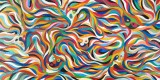


拉黑子.達立夫 2024〈ka’oripan 生命空間〉作品全景_日青創藝提供_李建霖 攝影 
拉黑子.達立夫 2024〈 ka’oripan 生命空間〉作品局部_日青創藝提供_李建霖 攝影 
拉黑子.達立夫 2024〈 ka’oripan 生命空間〉作品局部_日青創藝提供_李建霖 攝影 
拉黑子.達立夫 2024〈 ka’oripan 生命空間〉作品局部_林家卿 攝影
〈ka’oripan 生命空間〉 構樹皮、線, 270x400x3 cm
本作品嘗試著把taradaw跟edaw兩個概念放在一起,在阿美族語中taradaw是河流,edaw是儀式,另外還可以再談的一件事情就是malahedaw消失。這其中taradaw涉及的是一個自然從未停止演進的生態長河,以及edaw指涉人類試圖掌控一切的邏輯之腦。作品以構樹皮作為主要材料,這樣一個物種,曾經佔據先民文化相當重要位置,其所哺育的梅花鹿曾是一個時代的重要經濟,而它本身食用、藥用、儀式、慶典、衣料纖維等機能,亦曾標誌著島嶼人類很長一段時期的日常生活。如今它以最不起眼、甚至礙眼的方式出沒在被當代生活重複切割的各種空間邊界,近乎無所不在,無足輕重,卻也不曾離開,彷彿是種對人類的反向監看,紀錄著島嶼的生長與消退。我們所聽到的歷史,無論是四百年,或者往前延伸的數萬、數億年,其實都是非常模糊的,那些幽微或者劇烈的變化,或許我們嘗試著用邏輯歸納理解,透過儀式重新反省,然而回到malahedaw,所有的一切消失與否是否有其意義性,均非當下可以給予回應,終究只有那持續的在場、持續的觀察,我們才可能在某個瞬間的微光,好像懂得,但其實一點也無法肯定。
〈ka’oripan Life Space 〉broussonetia papyrifera (paper mulberry), thread, 270x400x3 cm
This artwork attempts to bring together the concepts of taradaw and edaw. In the Amis language, taradaw means river, and edaw means ritual. Another thing that can be discussed is malahedaw, which means disappearance. Among these, taradaw involves a natural ecological river that has never ceased to evolve, and edaw refers to the logic of the human mind’s attempt to control everything. The artwork uses paper mulberry bark as the main material. This species once occupied a very important position in the culture of the ancestors. The Formosan sika deer that fed on the paper mulberry was once the important economic source of an era. The paper mulberry, which itself can be used for food, medicine, rituals, celebrations, and fibers for making clothing, for a very long period marked the daily life of the island’s people. Nowadays, it appears in the most inconspicuous, even unsightly, manner at various spatial boundaries repeatedly cut by contemporary life. It is almost ubiquitous, insignificant, yet never disappears, as if it is a kind of reverse surveillance of humans, recording the growth and decline of the island. The history we hear, whether it is four hundred years or extending forward to tens of thousands or billions of years, is actually very vague. As for those subtle or dramatic changes, we may perhaps try to use logic to summarize and understand or reflect on them once more through ritual. However, returning to malahedaw, whether the disappearance of everything has significance or not cannot be answered at the moment. In the end, only through continuously remaining in place and observing the situation can we possibly catch a momentary glimpse, as if we understand; but in fact, we cannot be certain at all.
展覽介紹 (節錄)
「告訴我,島在哪裡——」作家賴香吟在她的名作〈島〉中,尋找著消失的主角「島」,「島」不見了。她走進「島」的書房,「她看盡島桌上所有資料,腦裡南城印象幾近重新洗牌,難以相信赤崁與安平之間曾是一片汪洋海域。熱蘭遮,普羅民遮,台江內海,五條港,彷彿一場太空漫遊,她在她所居住過的南城漂漂蕩蕩腳下踩不到底。」如果臺南是個漂浮於海上的「川流之島」,這個川流不息的島與島嶼臺灣的千年身世息息相關,那麼,臺南 400 會是一個契機,讓我們向這座浮島的南城提出一個問題:我們從何而來?我們往何處去?
我們從河而來。河流將山林的萬物沖積下來,成為丘陵、平原。當然,我們亦從海而來。洋流把世界史的變化載運往來,化成口岸、港市。《槍炮、病菌與鋼鐵》的作者賈德.戴蒙,從近代殖民戰爭與部落社會的演變,從島嶼的生境與歷史,推導出一個重要的結論:文化不只是人創造出來,而是和環境一起創造出來的。而人類文明的形成,有可能不依山、不靠海,卻不可能沒有依存的重要河川。臺灣中央脊樑山系連綿,形成天然集水屏障,加以降雨豐沛,所以島嶼的特色便是密佈的河川,紛紛以坡度降比極大、往東西兩側旺盛堆積,形成地貌變異快速、洪枯流量懸殊、短急切蝕入海的川流島嶼特質。因此,在作家吳明益〈且讓我們蹚水過河:形構臺灣河流書寫/文學的可能性〉一文中指出,臺灣文學的文本中,已將臺灣的河流轉化為「養育者」、「施暴者」與「受害者」三種基本的「認知地圖」。臺南的六條河川不僅養育了臺南城,也施予這片土地以暴雨、土石、洪流,更讓河流成為現代資本主義發展下的受害者。我們從河而來,我們往何處去?
2024 年,氣候變遷、極端型氣候造成的洪災、旱災、海岸線退縮日益明顯,整個城市與水體多物種的關係,經歷了 400 年的變化,如今面臨重新思考的「我們從河而來」的千年課題。
- 完整策展論述文章 請點選 https://www.tnam.museum/exhibition/detail/530
Curatorial Statement (excerpt)
“Tell me, where is the island—" writer LAI Hsiang-yin cries out in her renowned work Island, to her hometown Tainan that she keeps returning to in her dreams, searching for the missing protagonist “Island”, but “Island” is nowhere to be found. She steps into the study room of “Island”. “She went through all the data on Island’s table, her impressions of the southern city in her mind nearly reshuffled, hardly believing that between Chihkan and Anping there was once a vast ocean. Zeelandia, Provintia, the Taijiang Inner Sea, Wu Tiao Gang (the Old Five Channels), as if in a space voyage, she drifted in the southern city she had lived in, unable to touch the ground beneath her feet.” If Tainan is an “island of streaming” floating on the sea, this ever-flowing island is intimately related to the millennia-long history of the island of Taiwan. Then, “Tainan 400” could be an opportunity for us to pose a question to this floating city in southern Taiwan: Where do we come from? Where are we going?
We Are Born By The River. Rivers carry all things from the forests and mountains, forming hills and plains. Of course, we also come from the sea. Ocean currents carry the changes of world history back and forth, turning into ports and harbor cities. Jared Diamond, the author of Guns, Germs, and Steel, from the evolution of modern colonial wars and tribal societies, from the habitats and history of islands, deduced an important conclusion: Culture is not only created by humans but is created together with the environment. And the formation of human civilization might not depend on mountains or seas, but it cannot exist without significant rivers. Taiwan’s central mountain range forms a natural water-collecting barrier, coupled with abundant rainfall, hence the island’s characteristic dense network of rivers, rapidly accumulating on both the east and west sides with a steep gradient, forming a landscape of rapid topographic variations, vast differences in flood and drought flows, and short, sharply eroding rivers that flow into the sea, which are characteristic of the island of streaming. Therefore, as writer WU Ming-yi pointed out in his article Let Us Cross the River: Discussion on the Possibility of Taiwanese River Writing/Literature, the texts of Taiwanese literature have transformed Taiwan’s rivers into three basic “cognitive maps” of “nurturers,” “aggressors,” and “victims.” The six rivers of Tainan not only nurtured the city of Tainan but also inflicted this land with torrential rains, debris, and floods, further making the rivers victims under the development of modern capitalism. We are born by the river, but where are we going?
By 2024, the effects of climate change and extreme weather, including floods, droughts, and the retreat of coastlines, have become increasingly apparent. The relationship between the entire city and its aquatic biodiversity, after 400 years of change, now faces the millennia-old question of “We Are Born By The River” that needs rethinking.
- Curatorial statement excerpted from https://www.tnam.museum/exhibition/detail/530
▲ 展覽日期 Duration:2024.07.09(Tue.)–10.13(Sun.)
▲ 展覽地點 Venue:台南市美術館2館 Tainan Art Museum Building 2
▲本展更多資訊more info:https://www.facebook.com/bornbytheriver
 拉黑子‧達立夫 Rahic Talif